
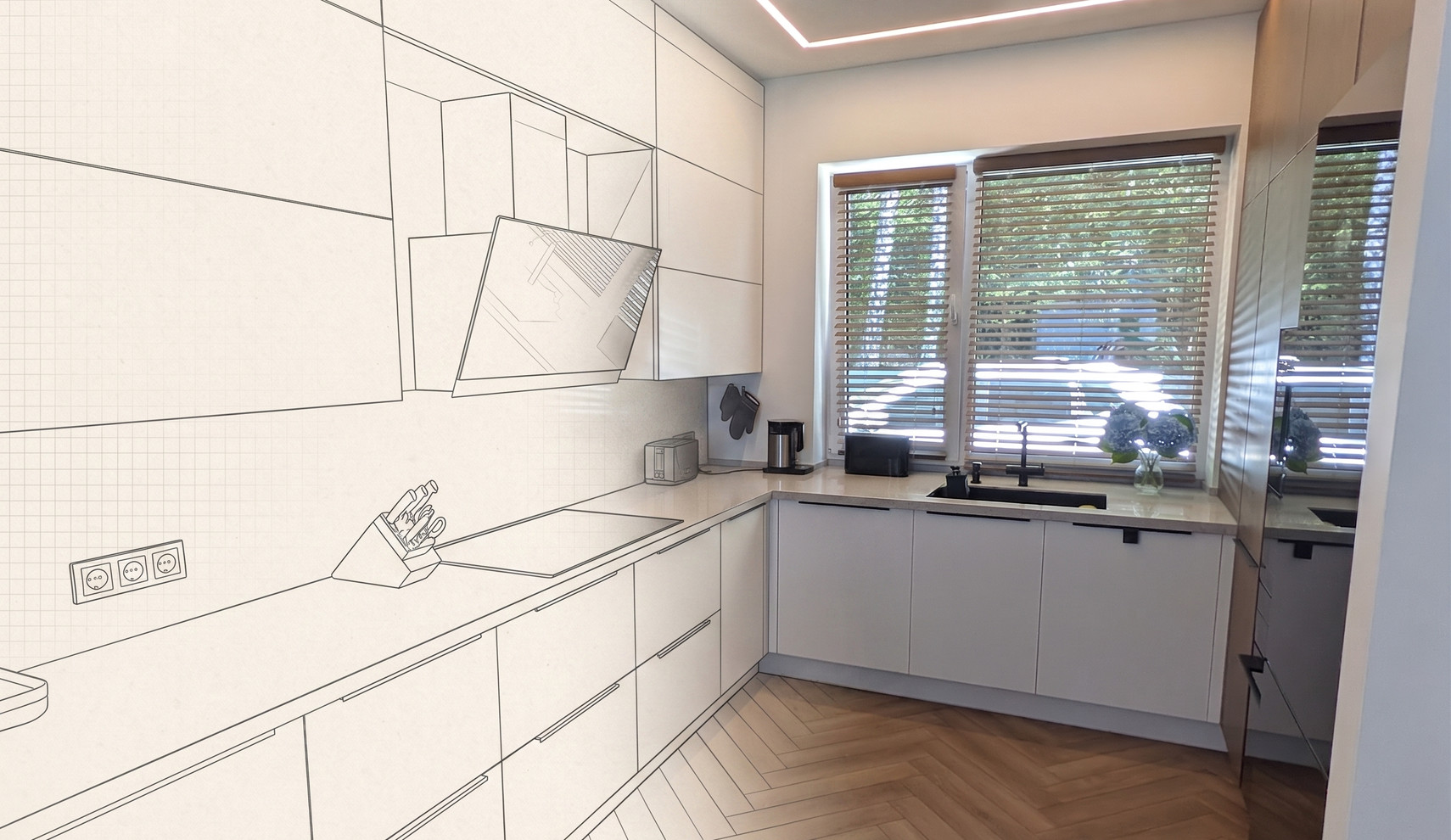
From a Kitchen project to Domuza
We are living in an era where technology—especially AI—is evolving at a breakneck pace. It is the perfect moment to be an active explorer and embrace new ways of learning. Instead of learning a specific technology first and then trying to figure out what to build with it, today’s landscape flips the script. Now, the most important thing is starting with a deep, painful human problem to solve.
For me, that problem emerged naturally during a major life transition. I was lucky enough to become a father to twins—a boy and a girl. With our growing family, the search for a more spacious home began. We bought a brand-new semi-detached house, which kicked off an ambitious, three-year interior design challenge.
The problem was my own kitchen
One of the biggest pain points—both financially and emotionally—was building the new kitchen. It was a massive undertaking because the kitchen is the beating heart of family life. I firmly believe that “you are what you eat,” and as a responsible father, prioritizing healthy, nutritious meals for my family every day is non-negotiable. To make that happen, you have to cook at home constantly. The kitchen isn’t just a place for food prep; it becomes a vital space for the whole family to live, connect, and grow.
When building the perfect kitchen, there is little room for error. It needs to be ergonomically flawless, spacious enough, and future-proof. As you grow and explore new culinary tastes, you don’t want to be held back by a poorly designed workspace. That realization was the start of my journey to build the perfect kitchen.
However, you immediately realize just how hyper-customizable a kitchen is and the staggering amount of attention to detail required. To get it right, you either have to spend countless hours researching every minor detail yourself, or you have to hire a designer. In my mind, the best approach is a blend of both—and that’s exactly where the idea for my product was born.
What I actually wanted to build — and how I planned it
It is built for the person who needs a perfect kitchen but has no idea where to start. It is for the homeowner feeling financial pressure, who wants to deeply understand where their money is going and avoid unnecessary expenses in such a complex project. With my product, you will have a simple, guided experience: you learn about your customization options on the go simply by chatting with an AI, and then your choices are validated by a professional human interior designer. Finally, once you know exactly what you want, the platform steps in to help you find the best price on the market.
So, I had the idea clear in my head. But what does it actually mean to start such a project? For me, the best approach was not to start building right away. Instead, I initiated an open-ended, extensive planning session. And you know what? Planning these days, with the help of AI LLMs, is such a relief—a genuinely pleasant experience.
I started evolving my idea using just a browser and the Google Gemini chatbot. Then, I discovered Air—an agentic development environment built by JetBrains, which I installed the moment its first version launched. This IDE was my top choice because it felt incredibly familiar to the Android Studio environment I use professionally. I also deeply appreciate the attention to detail in JetBrains’ products. Honestly, these tools—and a few subscriptions—were all I needed to get started.
The whole product lives in Markdown files
But as a creator, the most important thing you need is inspiration. In my opinion, inspiration cannot be rushed; it appears very randomly. The trick is not to wait, but to start documenting the moment it strikes. So, using the Air IDE, I began building a structure of Markdown (.md) files alongside my helpful AI. There were no strict rules or patterns I followed. My goal was simply to break everything down into small, separate .md files as much as possible. This approach helps me understand exactly what I am building, as each file tackles just one specific concept.
The truly fascinating part is that, as a builder, you create these files simply by having deep conversations with the AI. If anyone thinks you just sit down and manually type out rules in Markdown—it’s not like that anymore. The AI is clever enough to do the heavy lifting; you just provide the direction. I iterated multiple times. Inspiration hit me in completely different situations: sometimes late at night, sometimes after dramatic life events, sometimes just while listening to music or taking a shower. Basically, when you have an idea, don’t wait—add it to a document. My advice is not to rush and not to force yourself; that way, the final concept matures naturally.
Taking it to a real designer
Once practically all the .md files were ready, I needed to make my next move. You can iterate in isolation as much as you want, but there comes a moment when you need validation from other people. The fascinating thing about today’s tech is that you can simulate almost anything. For example, you can ask your AI chatbot to pretend to be a senior designer and review your project. However, I want to stop right here and remind us all that the most valuable, confidence-building experience is getting validation from real people.
That is exactly what I did. I went to meet Sandra, an interior furniture designer I had hired in the past. She is a true professional with years of experience, a mother of two (so she understands the needs of a growing family), and has great modern taste. We had a highly productive few hours at a local coffee shop, discussing the project and its potential benefits for both designers and furniture companies. The time flew by as we covered multiple pain points from both the customer and provider sides.
AI can rehearse the conversation, not replace it
An interesting fact: before the meeting, I had actually asked the AI chatbot to pretend to be a professional kitchen designer to validate my idea. When I met Sandra, she raised very similar points, but she also brought her own unique, real-world suggestions to the table. As I said, the experience of conversing with a real person is an absolute must. We build products for real people, and real people have emotions and feelings that you simply cannot simulate. By the end of our discussion, Sandra was eager to help me with the project, and we decided to collaborate. That’s a massive win.
To expand on the topic of validation, I want to stress just how crucial it is. This ‘Kitchen AI’ concept is actually an evolution of a hackathon idea I generated half a year ago. So, my validation process started as early as possible; I was just searching for the angle that resonated most with me. As I mentioned, the kitchen is just one part. I already have other verticals in mind for the future, because interior construction is such a vast domain. My main takeaway is this: when you are creating a product, think as broadly as you can. A grand vision becomes a powerful selling point for anyone deciding whether to believe in you.
The naming rabbit hole
With the concept validated and the documentation maturing, I walked straight into a trap every founder knows but nobody warns you about loudly enough: naming. What started as “let me quickly check a few domains” turned into weeks of late-night brainstorming. I built a whole naming matrix with my AI—scoring dozens of candidates on brandability, how they sound in both Lithuanian and English, trademark risk, and domain availability. At some point I caught myself writing shell scripts that checked domain availability in bulk, because manually typing name after name into a registrar at 1 AM quietly destroys your soul.
Here is my honest takeaway: naming matters, but it is also the perfect place to hide from real work. It feels productive while being, mostly, procrastination with a spreadsheet. If you find yourself three weeks deep in a naming matrix—stop, pick, move on.
Why Domuza, and why .lt
In the end, the winner was hiding in plain sight. Domuza—built on the Latin domus (home), short, ownable, and pleasantly app-like. What sold me is that it sounds like a parent brand, not a single-room tool: Kitchen by Domuza today, maybe Bathroom by Domuza someday—because home interiors are a much bigger domain than one room. And it doesn’t lean on the word “AI”, which I suspect will age better than half the startup names of this decade.
I bought both domuza.com and domuza.lt, and then made a deliberately boring, pragmatic call: domuza.lt is the primary home. The first market is Lithuania, and when someone googles “kiek kainuoja virtuvė”, a .lt domain carries the local trust and SEO signal that a global .com simply doesn’t. The .com just redirects and protects the brand for whatever comes later.
So that’s the starting line: a painful, personal problem; a validated concept; a professional designer on board; a stack of Markdown files that define the whole product; and finally—a name. The next post gets into the part that still feels a bit like science fiction: how this product is being built almost entirely by AI agents working through pull requests, while I act as the editor-in-chief. Stay tuned.
